What employers are really looking for today
Moving into a HEOR Manager or Director role is no longer just about adding years of experience. Expectations have shifted, and job titles now hide very different responsibilities than they did even a few years ago.
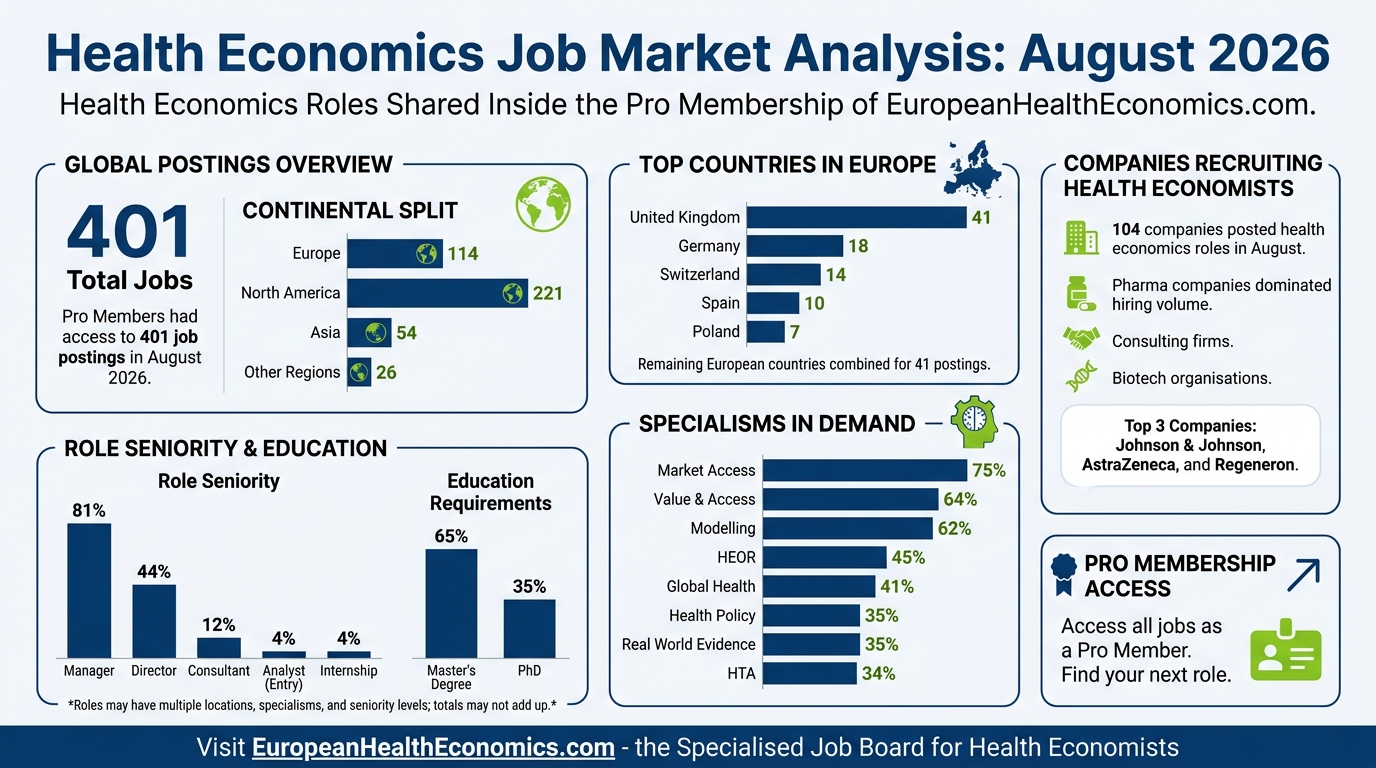
This briefing is based on an analysis of 80 HEOR Manager and Director job descriptions across the world, all available through the Pro-medlemskap of EuropeanHealthEconomics.com. It highlights what organisations are actually prioritising today: the growing integration of real-world evidence, the split between strategic and technical leadership paths, and the increasing emphasis on judgement over tools when it comes to AI.
Across these roles, several consistent patterns stand out. Not aspirational wish lists. What organisations are actively hiring for right now. You can see the current 199 HEOR roles here.
Whether you’re a Senior Manager preparing for the next step or a Director considering a move, this is a peer-to-peer snapshot of how the market looks today.
1. Manager level: the strategic engine
At Manager and Senior Manager level, the market is no longer looking for purely hands-on model builders. The expectation is broader. You’re now the link between technical delivery and strategic intent.
Vendor management
You’re still expected to work directly in Excel, R, or Python. That hasn’t gone away. What has changed is the weight placed on vendor management. Managers are now expected to coordinate external suppliers, oversee quality, and keep delivery on track across multiple workstreams. You’re no longer just building the model. You’re making sure the overall plan gets delivered.
Translation to non-health economists
One of the most frequently repeated requirements is the ability to explain complex work in plain language. Managers are expected to translate technical outputs into clear narratives for commercial, medical, and market access colleagues. Being able to explain why the analysis matters is now just as important as running it.
Experience window
Experience requirements are converging. Most Manager roles ask for roughly 3–5 years of relevant experience, whilst Senior Manager roles typically fall into the 5–8 year range. The market appears less flexible here than in previous years.
2. Director level: from oversight to leadership
Moving from Manager to Director remains a significant step change. Technical expertise is assumed, but it’s no longer sufficient.
Setting direction
Director roles consistently emphasise ownership of evidence strategy. This includes defining the Integrated Evidence Generation Plan and shaping how evidence supports an asset across its lifecycle. Directors are expected to anticipate payer and HTA needs early and influence clinical development so the right endpoints are captured in time.
Influence
Job descriptions place heavy emphasis on influence. Directors are expected to engage confidently with senior leadership, including VPs and General Managers, and guide cross-functional teams without relying on formal reporting lines. The ability to persuade and align stakeholders is a core part of the role.
Budget ownership
Financial responsibility moves from a task to a core accountability. Directors are responsible for managing substantial HEOR budgets, prioritising resources, and maintaining delivery standards across portfolios.
3. A clear split: Product lead vs centre of excellence
One of the more striking patterns is the clear divergence in senior-level career paths.
The asset strategist
In product-focused roles, Directors act as the HEOR lead for a specific brand. They sit within cross-functional commercial teams and own the overall value story, spanning economic modelling, real-world evidence, and patient-reported outcomes.
The technical specialist
Other organisations are building Director-level roles around centres of excellence: modelling, value communication, or methods development. These positions aren’t tied to a single asset. They set standards and provide technical leadership across the organisation. For those who prefer methodological depth over brand leadership, this path is increasingly visible.
4. RWE is no longer separate from HEOR
The traditional separation between HEOR and Real-World Evidence continues to erode. Many senior roles now explicitly combine both areas.
Director-level positions increasingly expect leaders to drive RWE strategy alongside economic modelling. Familiarity with claims data, electronic health records, and registries is becoming a baseline expectation rather than a niche skill.
Hands-on programming is rarely required at this level, but many roles still reference SAS or R experience as a way to ensure leaders can critically assess data quality and methodological choices.
5. Early signals around AI and digital approaches
A newer, still-emerging trend is the inclusion of artificial intelligence and digital health in senior job descriptions, typically framed around improving efficiency or exploring new ways of generating evidence.
What organisations appear to be looking for is not technical mastery, but judgement. Directors are expected to understand where AI-based approaches add value, where they’re premature, and how they fit within credible, defensible evidence strategies.
The bottom line
Progression in HEOR is no longer just about technical capability. The question has shifted from “Can you do the analysis?” to “Can you shape the narrative, manage delivery, and influence decisions?”
The market is clearly asking for stronger cross-functional judgement, ownership, and commercial awareness, whether you go deep on technical leadership or broad on asset strategy.
The role is bigger. So is the expectation.
Your Next Steps
Browse current 199 HEOR Manager and Director roles to see how organisations are defining these positions today, or explore Pro-medlemskap for full access to all manager or director opportunities on the job board.
5 dagars gratis testperiod. Avsluta när du vill.