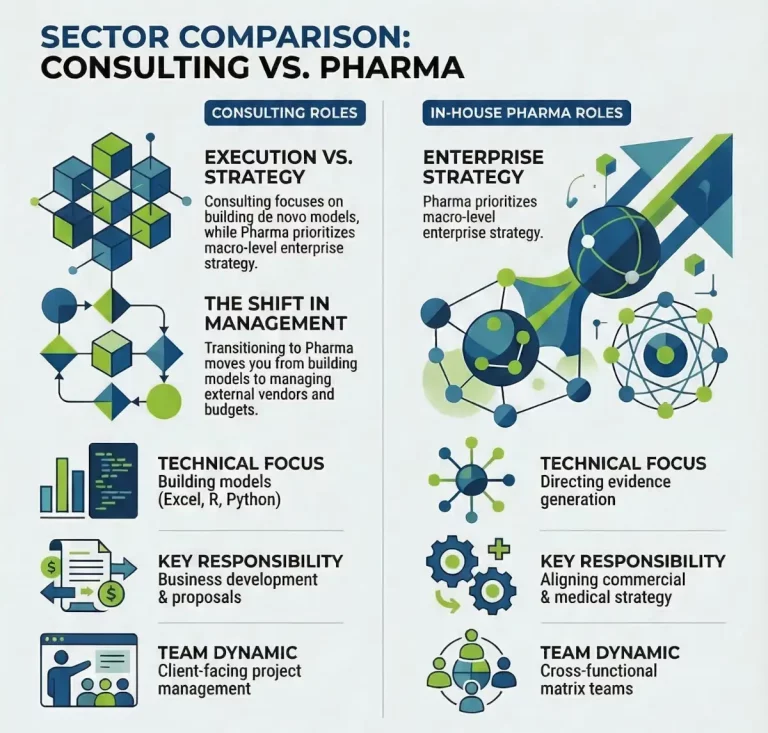
What is Actually Different?
If you are exploring Health Economics and Outcomes Research (HEOR) roles, you have probably noticed that job postings from pharmaceutical companies look quite different from those at consultancies. That is not a coincidence. A review of recent HEOR job postings reveals a distinct structural divide between the two sectors. Understanding this divide helps you judge where your skills fit best, and where your career could go next. Below is a breakdown of how core responsibilities, daily tasks and strategic expectations differ across these two operating environments.
What You Do in Consulting
Consulting and agency roles prioritise rigorous technical execution and direct client management. If you work in a consultancy, you will frequently build de novo economic models using software such as Excel, R and Python. Your days revolve around hands-on analytical work, designing models, running analyses and delivering results to external stakeholders.
But the job does not stop at technical delivery. Consultancies consistently expect you to contribute to business development, proposal writing and securing repeat business from clients. In short, you are not just a modeller; you are also part of the commercial engine. The operational focus remains heavily on methodological rigour and project-based execution for external stakeholders.
What You Do in Pharma
In-house pharmaceutical positions sit at a different level. Here, the focus shifts to macro-level strategy and cross-functional alignment. You direct evidence generation to support commercial, medical and regulatory objectives across matrix teams, rather than producing the evidence yourself.
In practice, this means you are less likely to code models directly. Instead, you oversee external vendors and consultancies that perform the technical execution. Your daily reality involves managing research budgets, validating external work and ensuring everything aligns with enterprise strategy. Think of your role as the architect, not the builder.
How Skill Requirements Differ
This structural divide creates distinct skill expectations, and knowing which set matches yours matters when you are choosing your next move.
Consulting
Consultancies explicitly demand high proficiency in statistical programming and hands-on data analyses. You need to be comfortable building, coding and troubleshooting models from scratch. Technical output is what gets measured.
Pharma
Pharmaceutical roles heavily emphasise matrix leadership, the ability to influence without authority and vendor management capabilities. You need to steer teams and external partners towards a shared strategic goal, even when you do not have direct control over them.
Both environments require a strong foundation in health economics. However, consultancies index higher on technical output, while pharmaceutical companies prioritise strategic translation, turning evidence into decisions.
What the Market Tells You
The HEOR job market segments clearly between the technical execution required in consultancies and the strategic oversight demanded by pharmaceutical companies. Consultancies focus on hands-on modelling, business development and client management. Pharma roles centre on vendor management, budget allocation and cross-functional strategy.
Neither path is better. But they are different, and understanding that difference puts you in a stronger position when you apply.
If you would like to see all the HEOR roles currently posted on EuropeanHealthEconomics.com, you can access them with the Pro Membership. You can try the Pro Membership free for five days.
EuropeanHealthEconomics.com is the specialised job board for health economists, created by health economists.