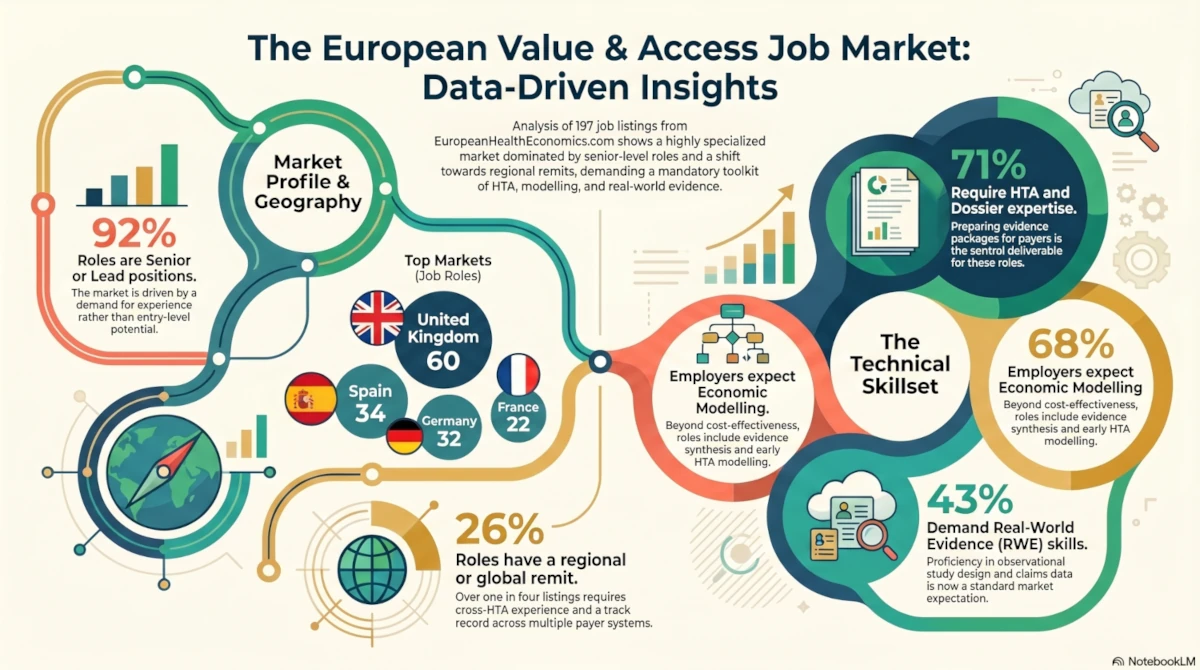
What do Value & Access roles involve, and what do you need to get hired? Here are the typical responsibilities and the education and work experience employers ask for at each level. This analysis is based on 44 Value & Access Rollen posted in the Pro membership of EuropeanHealthEconomics.com.
Value & Access sits between the evidence and the commercial outcome. The job is to make sure a medicine or diagnostic gets reimbursed at a price that reflects its value, so patients can actually get it. The titles vary: value, access & pricing; value, evidence & access; value & access insights. But the work follows a recognisable pattern.
The label is broad, though. In this sample, “Value & Access” covered global strategy directors, country access leads, dossier writers, payer analytics specialists and even data engineers. Before you apply, read the responsibilities, not the title.
What are the responsibilities?
Most of the work falls into three themes.
1. Strategy
Almost every listing asks you to develop access, pricing and reimbursement strategy across the product lifecycle and to build the value proposition that turns clinical and economic evidence into arguments payers accept. In global roles this starts early: identifying evidence gaps, shaping trial endpoints and comparators, and feeding pricing assumptions into forecasts and business development decisions.
2. Submissions and evidence
You’ll prepare or oversee HTA dossiers and value dossiers, adapt global material to local requirements, and increasingly prepare for JCA. Much of this runs through agencies, so managing vendors, budgets and timelines comes up repeatedly.
3. Influence
Nearly every listing stresses cross-functional work with Medical, Commercial, HEOR, Clinical and Regulatory teams, usually without direct authority. Country roles add payer engagement and negotiation. Global roles add training and equipping affiliates with toolkits and objection handlers.
Outsourcing modelling
One finding matters if you come from HEOR: you’re more likely to commission models than build them. Only a handful of listings, mostly in value analytics, writing and consultancy, expect hands-on cost-effectiveness or budget impact modelling. Most roles ask you to partner with HEOR. If you’re moving across, your edge is translating evidence into payer arguments and judging whether a model will survive HTA scrutiny.
What are the requirements?
| Level | Typical education | Typical experience |
|---|---|---|
| Entry (interns, associates, analysts) | Master’s in most European listings | 0 to 2 years |
| Mid (senior specialists, senior associates, country leads) | Master’s | 3 to 7 years |
| Senior: managers and directors | Managers: Master’s or graduate degree, PhD often preferred. Directors: Bachelor’s minimum, advanced degree preferred | Managers: 4 to 6 years. Directors: 8 to 12+ years |
Entry level: a Master’s is the norm, even for internships. Country roles also require the local language plus English.
Mid level: a Master’s is the standard expectation, typically with 3 to 7 years of experience.
Senior level: manager roles have the highest academic bar in the dataset, and a PhD can cut the experience requirement by 2 to 4 years. At director level, degrees matter less. Listings screen for years in market access und therapeutic area depth, with oncology most in demand (based on fewer listings, so treat this as indicative). If you’re aiming for director roles, build that depth while you’re still at manager level. Many global director roles are individual contributors with no direct reports.
See all the jobs with Value & Access responsibilities here.